


If anyone can speak to the “end of an era” nostalgia coursing through the legacy-minded 2026 Sundance film festival, its final edition in Park City and its first without founder Robert Redford, it would be Jay Duplass. The film-maker first attended the indie festival along with his brother Mark in 2003, with a self-proclaimed “$3 film”, then went on to premiere three projects – The Puffy Chair, Baghead and Cyrus – that epitomized the much-debated, very indie mumblecore movement of yore. For the Duplass brothers, the festival was, as it has been for many a small-budget artist trying to break out, the difference between a career and another $3 film. Without Sundance, he recently joked: “I’d probably be a psychologist right now.”
Psychologist sympathies peek through See You When I See You, Duplass’s feature film return to the festival after 16 years largely focused on acting and directing episodic television, notably for Togetherness, Search Party and the criminally underseen Somebody, Somewhere. An earnest adaptation of comedian Adam Cayton-Holland’s memoir Tragedy Plus Time, the 102-minute film is both a straightforward tribute to psychotherapy and a tightrope walk of tone, attempting to balance profound grief with breezy comedy for a family reeling from a shocking loss.
That See You When I See You often stumbles is occasionally frustrating but mostly forgivable, given the highly personal material and the sincere handling of trauma that would end me; like Cayton-Holland, who also wrote the script, Adam, played by former Sundance darling Cooper Raiff, lost his younger sister to suicide. In fact, he was the one to find Leah (Kaitlyn Dever), revealed in flashbacks to be his best friend and vital co-conspirator, at her Denver home.
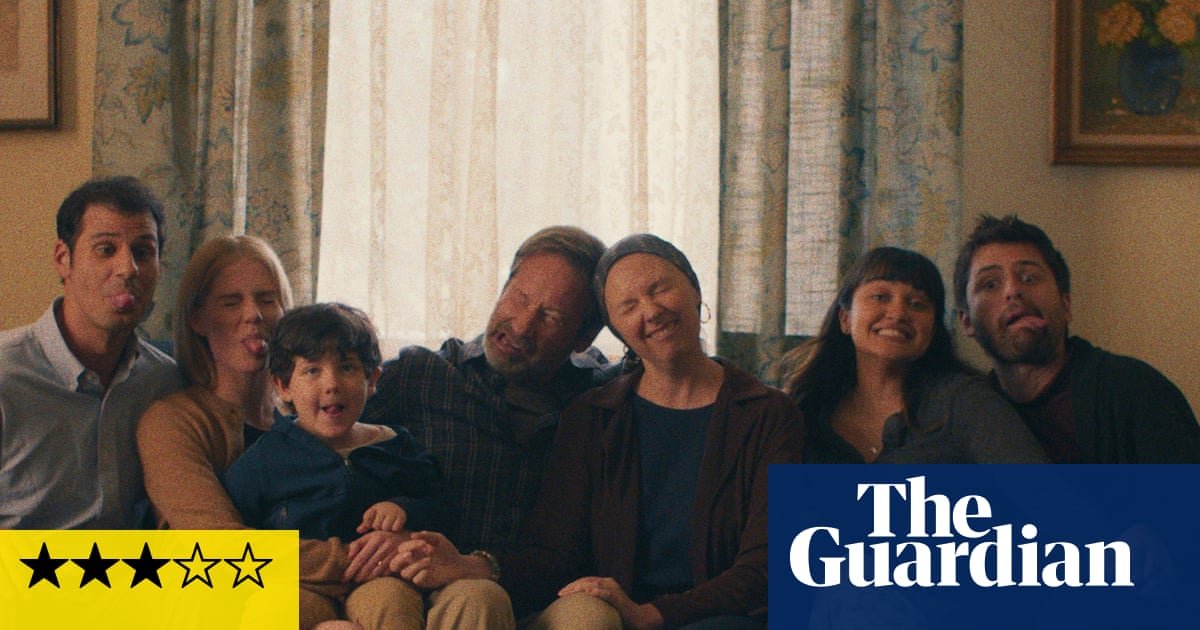
There is no single or right way to handle grief, of course, though I must admit that I initially tripped over the borderline jaunty tone of the Whistler family’s banter in the near-immediate aftermath, cracking light jokes at a forced rhythm within a debate about whether or not to hold a funeral. (An often sprightly, upbeat score by Jordan Seigel contributes to the confusion.) Still, everyone is coping in their own way: mother Paige (Hope Davis) is throwing herself into her conservation work. Father Robert (David Duchovny), a civil rights attorney is compulsively telling everyone about what happened. That horrifies older sister Emily (Lucy Boynton), Robert’s law partner, who prefers to hyper-fixate on logistics and a funeral, so she can be done with it all.
Though the film feints at significant subplots for each of them – Davis conveys a world of feeling in one glance; after discovering a lump in her breast, you know she doesn’t have it in her to see a doctor – this is ultimately, for better and worse, Cayton-Holland’s story, and Adam’s rom-dramedy. He is clearly spiraling – listless at work, getting a DUI and, in one realistically relayed text exchange (finally!), hitting up the girl he abruptly ghosted two months ago. See You When I See You (a seemingly odd that title that eventually makes sense) awkwardly swerves between underplaying Adam’s struggles – such as playing his stalking of said girl, Camila (How To Blow Up a Pipeline’s Ariela Barer), for laughs – and literalizing his grief, in flashbacks that morph into confrontations with Leah that end with her somewhat over-dramatically disappearing into the void.
Those scenes, meant to convey the intrusive thoughts and tainted memories ripping through Adam’s life, are still effective, mostly because Dever conveys both spiky vibrancy and unreachability in a handful of minutes. Raiff, on the other hand, feels opaque; in memory purgatory, both he and the character seem out of their depths. A Duplass protege whose film Cha Cha Real Smooth was one of the biggest-selling films of Sundance 2022, he fares much better in the familiar lane of talky comedy, speaking in his usual offbeat bursts and self-deprecating his way to the girl (that would Camila, who seems rightfully exhausted by a clumsily shoehorned in rom-com plot). That may grate for some, but I found Raiff’s usual schtick endearing when applied to a character with a very good reason for feeling singularly disconnected and adrift in the world.
He finds recourse through eye movement desensitization and reprocessing (EDMR) therapy for PTSD, in which Dr Anya (Poorna Jagannathan) and handheld pulsators help Adam relive and rewire the memories from the worst night of his life. Duplass plays these scenes completely straight, from the stated intent – to put the traumatic memory into the right file and gain agency over his mind – to the literal process of returning, again and again, to Leah’s bathroom door. There’s something noble, even ambitious, in depicting such a clinical process, though I’m not sure how Duplass figured out how to do so cinematically; what should, I think, have taken us to the emotional brink, finally opening the door on the immense pain, left me with but a lump in my throat.
To be fair, I simply cannot fathom facing what Adam has to, and resist attempts to think about it in the same way I resisted some of the film’s perkier comic deflections. Perhaps that’s a failure of my imagination, and those forced to endure the unthinkable will find something comforting and validating here. But for a film so sincerely intent on bringing us into the process of sibling grief, I still left a stranger.