


The title of Andrzej Wajda’s 1958 film is taken from lines by the Polish Romantic poet Cyprian Norwid: “Will there remain among the ashes a star-like diamond, the dawn of eternal victory?” They are words imbued with bleak irony and disillusion; a pair of lovers in this movie discover them written in a ravaged church and have difficulty deciphering them, and also cannot decide where their loyalties and future lie as the second world war comes to its chaotic end. Are the diamonds of future law-abiding peacetime prosperity under communist rule – that is, effective rule by those who started the war invading Poland in league with the Nazis – preferable to the ashes of wartime suffering which at least offered certainty and purpose?
The scene is a provincial Polish town on VE Day, 8 May 1945. Across the continent, there are complex and unresolved feelings under all the celebration, nowhere more so than in Poland, the historic centre of the European war. Maciek (Zbigniew Cybulski), Andzrej (Adam Pawlikowski) and Drewnowski (Bogumił Kobiela) are three fighters in the home army resistance movement, patriotically opposed to communists as much as Nazis. They consider their mission in no way halted by the end of the war, but they have just grotesquely bungled their latest task of assassinating Communist party apparatchik Szczuka (Wacław Zastrzeżyński); lounging around and sunbathing before the hit, they accidentally kill two innocent young people.
Nauseated by his failure, horrified by accidentally witnessing the grief of a young woman engaged to one of his two innocent victims, and realising himself exhausted by the war’s end, Maciek is nonetheless ordered by his superiors to try again. He must kill Szczuka, who is due to attend a victory banquet and stay overnight at the seedy state-run Hotel Monopol, whose name is a twist of black comedy on its own. Maciek gets a room next to the one occupied by Szczuka, who is to learn that his own teenage son is working for the insurgents. Maciek flirts with barmaid Krystyna (Ewa Krzyżewska) and inveigles her to his room, which is now more important as the site of lovemaking than a base for political killing. He is struck by a terrible epiphany: he is in love with Krystyna, or at any rate he knows he is now a lover, not a fighter. The war is over. If he refuses this mission, it won’t mean he is a coward or a traitor … will it? Why did he want to kill this man anyway? Or anyone? What has it all been for? “I can’t kill or hide any more!” he wails to his commanding officer, who remains unmoved.
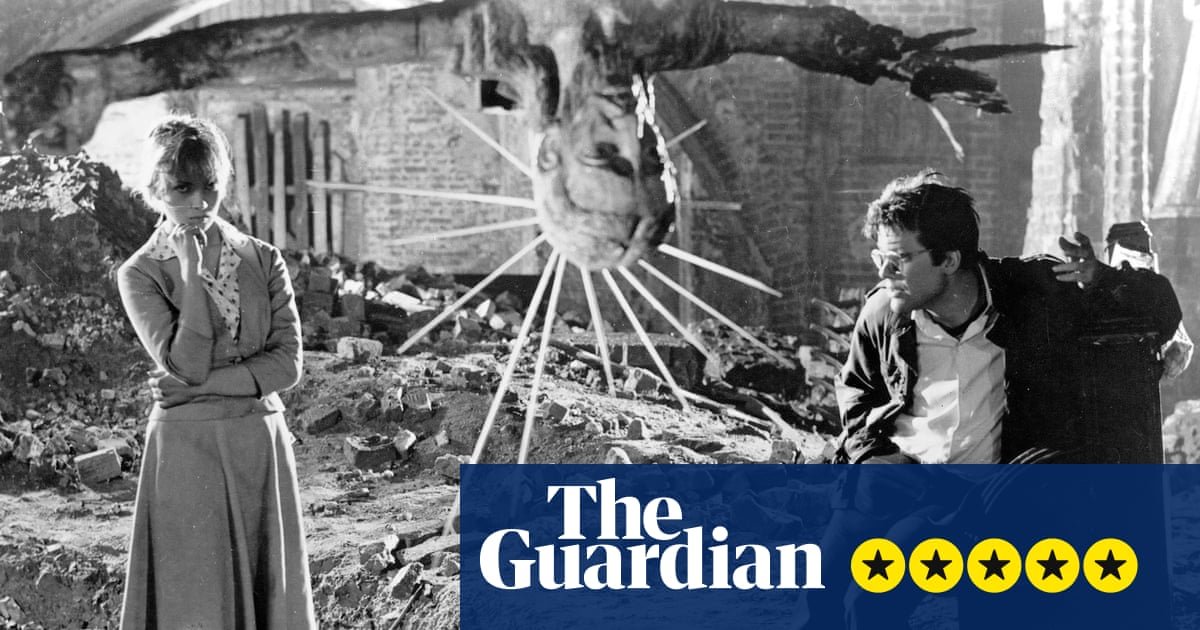
Meanwhile, the banquet continues and degenerates into a drunken bacchanal. Drewnowski gets horribly drunk while angling for a job in the press under the new dispensation; scenes showing squares of newsprint used as lavatory paper give a clear indication of just how noble that is. Maciek and Krystyna wander the streets, encounter a ruined church where the crucified Christ now swings crazily upside down, encounter Norwid’s poem and make a terrible discovery about who else is there.
Why does Maciek wear dark glasses, asks Krystyna. Maciek replies: “A souvenir of unrequited love for the homeland.” The sunglasses make him look perennially in disguise, incognito, unable to show his loyalties. He will ultimately take them off, but there is no corresponding liberation or revelation. Everywhere in this film is sadness and a kind of delirium: the film was made just 13 years after the events it described; the original novel by Jerzy Andrzejewski on which it is based just three years. It is a testament to Poland’s crisis of identity and ideology.